
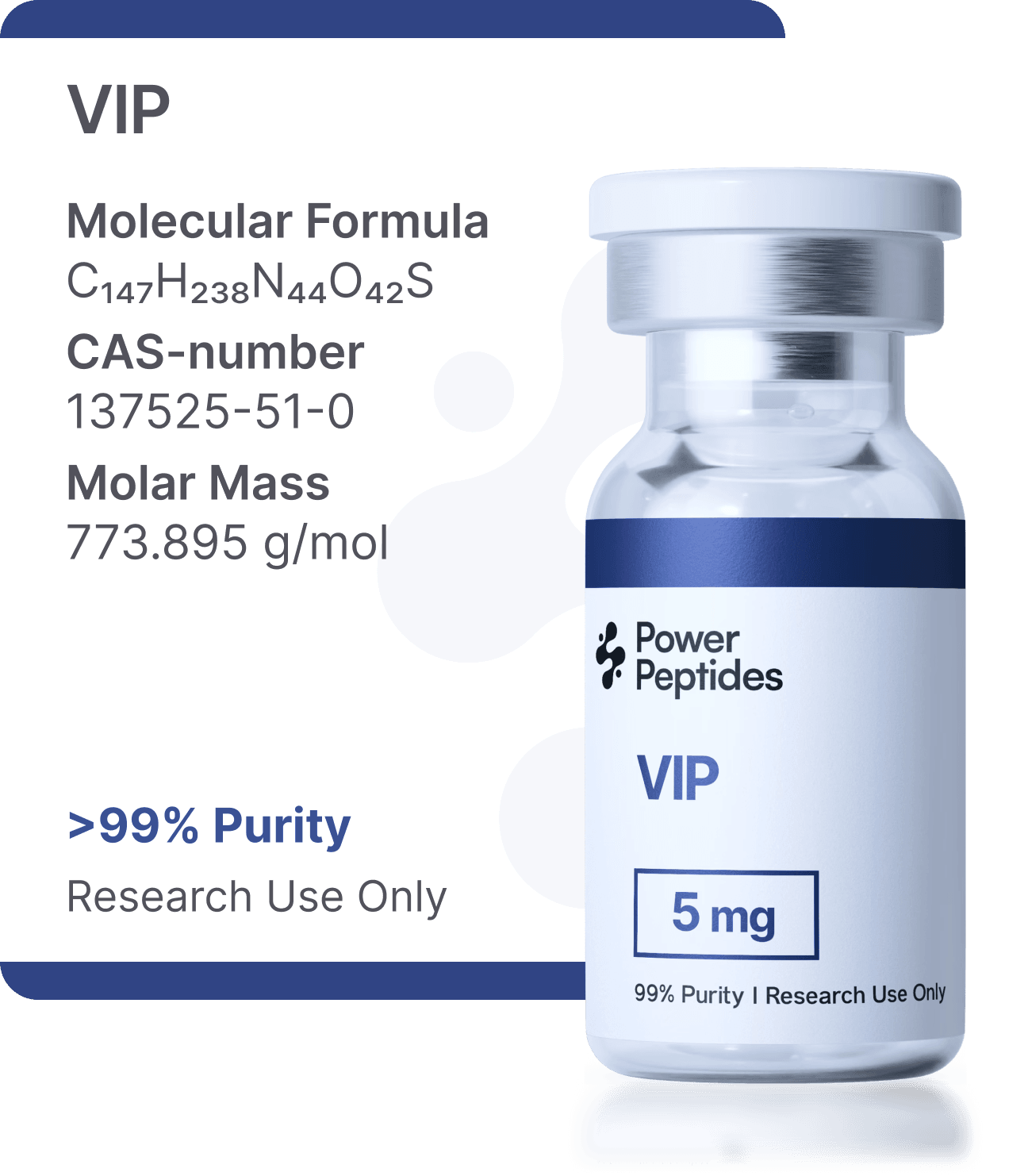

VIP
VIP research compound, also known as Vasoactive Intestinal Peptide. Supplied as a lyophilized peptide reference material for laboratory research applications.
This product is purity-tested for compound identity and is intended for in vitro experimentation, analytical reference, or scientific characterization studies.
For laboratory research use only. Not for human or veterinary use.
$69.99
⚡️ Ships Today if ordered within 8 hrs.
🚚 Free FedEx 2Day® on orders $300+
🚚 Free FedEx Standard Overnight® on orders $1000+
♻️ Third party tested.

Product Details
Characteristics
| Molecular Formula | C147H238N44O42S |
| CAS | 137525-51-0 |
| Molar Mass | 773.895 g/mol |
| Amino Acid Sequence | His-Ser-Asp-Ala-Val-Phe-Thr-Asp-Asn-Tyr-Thr-Arg-Leu-Arg-Lys-Gln-Met-Ala-Val-Lys-Lys-Tyr-Leu-Asn-Ser-Ile-Leu-Asn |
| Synonyms | VIP, Vasoactive Intestinal Polypeptide, PHM27 |
| Solubility | Soluble in Water |
| Organoleptic Profile | White powder |
| Composition | Lyophilized powder – requires reconstitution |
How is VIP studied?
Vasoactive Intestinal Peptide (VIP) is a 28-amino acid neuropeptide that has been explored in preclinical laboratory research for its interaction with G protein-coupled receptors such as VPAC1 and VPAC2. These receptors are expressed in various mammalian tissues, including the brain, intestines, and immune-related cells. In mammalian research models, VIP peptide has been observed to activate signaling pathways, including those involving cyclic AMP (cAMP), which play a role in cellular communication. These studies have explored VIP’s role in smooth muscle biology, glandular secretion, and immune cell signaling under controlled laboratory conditions. The research continues to advance understanding of complex cellular response mechanisms but does not provide conclusions regarding VIP peptide dosage, safety, or efficacy in humans.
Research Focus
Vasoactive Intestinal Peptide (VIP) has been studied in preclinical laboratory models for its role in several biological systems. In these research environments, VIP has been explored for its potential influence on:
- Cell signaling pathways associated with inflammation
- Neural cell communication and protection mechanisms under oxidative stress conditions
- Immune response modulation, including signaling interactions involving T cell subsets
- Smooth muscle behavior and vascular signaling
- Respiratory and gastrointestinal cell models examining glandular and barrier function
Preclinical Observations
In preclinical laboratory studies, Vasoactive Intestinal Peptide (VIP) peptide has been investigated for its effects on biological systems such as vascular tone and gastrointestinal secretion. Some studies in mammalian models have reported changes in blood pressure, smooth muscle behavior, and glandular activity as part of the research findings. It is important to note that VIP has not been evaluated or approved for human use, and its effects in humans are not established.
Summary
Vasoactive Intestinal Peptide (VIP) is a 28-amino acid neuropeptide that has been studied in preclinical laboratory settings for its role in various biological systems. Research in mammalian models has examined VIP’s interaction with pathways involved in vascular tone, smooth muscle behavior, immune response, and cellular signaling. These investigations support its relevance in advancing understanding of neuroendocrine and immunological functions. However, VIP is not approved for human or veterinary use, and no definitive conclusions can be drawn about its safety, efficacy, or ideal VIP peptide dosage outside of experimental settings.
References
- Moody TW, Hill JM, Jensen RT. VIP as a trophic factor in the CNS and cancer cells. Peptides. 2003 Jan;24(1):163-77. doi: 10.1016/s0196-9781(02)00290-5. PMID: 12576099.
- Gozes I, Brenneman DE. VIP: molecular biology and neurobiological function. Mol Neurobiol. 1989 Winter;3(4):201-36. doi: 10.1007/BF02740606. PMID: 2698176.
- Bellinger DL, Lorton D, Brouxhon S, Felten S, Felten DL. The significance of vasoactive intestinal polypeptide (VIP) in immunomodulation. Adv Neuroimmunol. 1996;6(1):5-27. doi: 10.1016/s0960-5428(96)00008-3. PMID: 8790778.
- Robert J Henning, Darrell R Sawmiller, Vasoactive intestinal peptide: cardiovascular effects, Cardiovascular Research, Volume 49, Issue 1, January 2001, Pages 27–37
- Delgado, M., Pozo, D. and Ganea, D., 2004. The significance of vasoactive intestinal peptide in immunomodulation. Pharmacological reviews, 56(2), pp.249-290.
- Fahrenkrug, J., 1993. Transmitter role of vasoactive intestinal peptide. Pharmacology & toxicology, 72(6), pp.354-363.
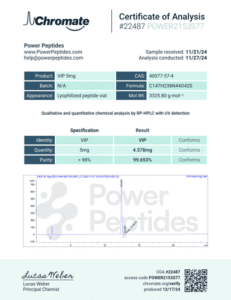
Certificate of Analysis (COA)
Resource
Research Peptides Supported by Verifiable Testing
Power Peptides™ is more than just a U.S. supplier of research peptides. We are helping to power the next wave of peptide research by providing peptides that support our clients’ work.
Consistent Quality Standards
Our internal processes and meticulous material sourcing practices drive consistency. Our peptides meet rigorous internal quality standards.
Independently Verified
Every product undergoes extensive testing, both in-house and through independent, third-party laboratories.
Fast Shipping & Support
We provide fast and reliable shipping, using established couriers and high-quality packaging materials. This helps to ensure that your peptides arrive promptly and in optimal condition.